|
BELKIN PF40
HISTORY and COMMENTS
|
In the 2000s home theater owners were investing heavily in Blu-ray, digital receivers,and plasma TVs to take advantage of Lucasfilm THX, Dolby Digital, and DTS surround. In this less-green time it was a status symbol to have a bank of power amplifiers and a complete home theater library of locally stored content. Today, the shift towards cloud-based content has moved to smart TVs with soundbars. The result is less space for a dedicated surge supressor yet protecting AV equipment from noise is just as important as before.
BELKIN was founded in southern California in 1983 by Chet Pipkin in his parent's garage. A great personal story as today Belkin is now a worldwide company and owns both Cisco and Linksys. In the early 2000s they released line conditioners for the consumer AV market. These were stylish units with the Belkin stamp of quality to fill a necessary home theater niche. Models were the PF-30, 40, and 60. In a mysterious move around 2010 Bekin decided to discontinue the entire line, much to the disappointment of the AV community. It was a shame because these were affordable quality units with unique styling and elegant displays instead of the rough industrial look of other brands. A competitor Monster Cable made sylish units that were well regarded but were also discontinued around the same time.
 |
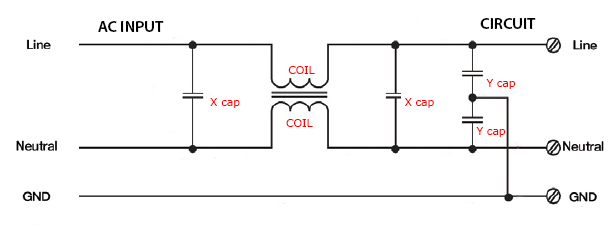
| STAGE 1 FILTER For AC line filtering its important to understand the Stage 1 filter which has been around for decades and used extensively worldwide. The purpose of a Stage 1 filter is to block EMI/RFI above 60Hz almost like a speaker crossover. However only so much filtering can be added without causing insertion loss (voltage drop) and distorting the 60HZ sine wave. UL (Underwriters Laboratory) certifies this simple filter on US power grids which means that Stage 1 filters are pretty much the norm in line conditioners even high end models. - Special "X" and "Y" type capacitors are used. One X cap goes between the rails (called Differential mode) while two Y caps go from rail to ground (called Common mode). An X type burns through when blown while the Y keeps drawing current when blown to maintain grounding. These caps filter out EMI/RFI. - Toroidal chokes and wire-wound coils are used inline with each rail to filter out high frequencies. - A MOV is sometimes used inline with each rail at the outputs. These increase resistance as voltage rises and clamp down on spikes. |
 |
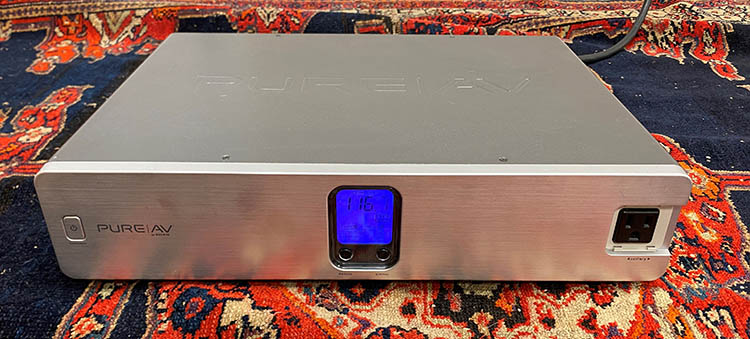
In 2006 I bought a new PF40 mailorder from 6th Street Photo. With PURE AV stamped in the top cover and front it had a high-tech look. A front AC outlet had a neat little silver cover.
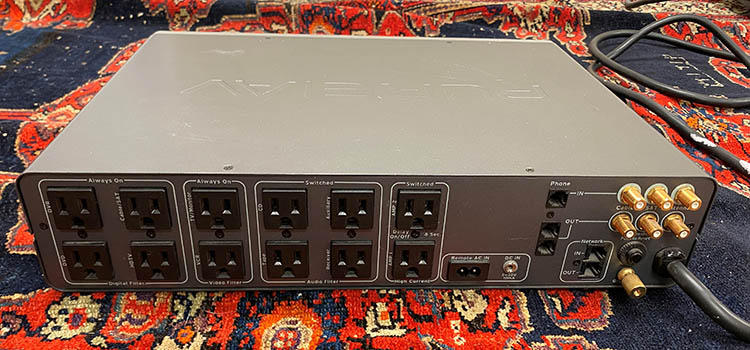
This unit has protection on 6 coaxial jacks for cable/satellite in addition to ethernet and telephone line protection. Two of the switched outlets are high current versions specifically for amplifers. |
 |
BELOW: The PF40 layout is clean and functional. AC from the wall passes to the power supply board and transformers on the left. AC then passes to the 2nd board where four banks of Stage 1 filters with MOVs travel to the rear outlets. Large ferrite beads are used on each outlet. Belkin promoted its "Purefilter" circuit as a key feature. The manual says "The multiphase PureFilter Circuitry provides true isolation between audio, video, and high-current components". This term simply means there are individual filter banks. |
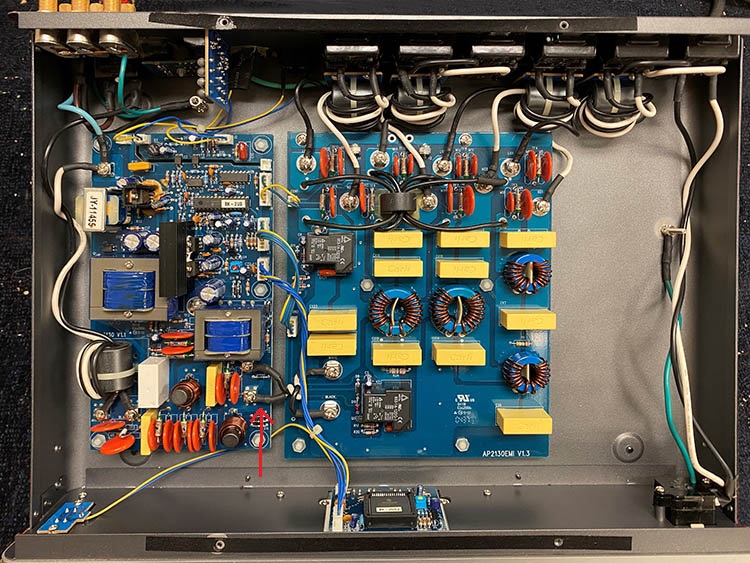 |
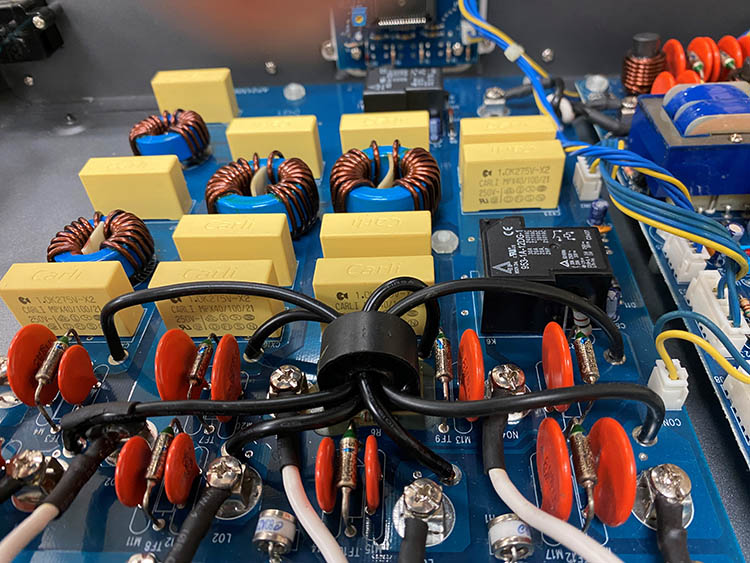
A closeup reveals X2 caps, coils, and orange MOVs. The small silver components between the orange MOVs are thermal fuses. The use of multiple Stage 1 filters and attention to detail and layout is top notch in my opinion |
 |
| CONCLUSION So do line conditioners serve a purpose? Absolutely! Creating a safe harbor for your equipment should be a priority. The amount of EMI/RFI on modern power grids is significant. Lightning strikes and power surges are even more damaging. Allowing them to pass into expensive TVs and AV systems is very risky and irresponsible to ignore in my opinion. So its puzzling that surge suppressor companies chose to give cute names to their circuits rather than explain them in detail.
By dumbing-down AC filtering the companies may have contributed to a perception that these products are snake oil, which is very far from the truth. If they had described in detail the circuit inside so AV buyers could make comparisons between brands and models these products would have dominated the market. Even today quality brands such as Furman and Panamax state the features of EMI/RFI noise filtering but don't explain how they accomplish it. Why be so mysterious? This is a missed opportunity. A look under the hood by reviewers and manufacturers would have gone a long way in building consumer confidence in what is an unnecessarily vague product.
|
Datsunzgarage.us © 1997-2026
All mods are illustrative only, perform at your own risk.
Datsun is a registered trademark of Nissan®